CLICK HERE FOR THOUSANDS OF FREE BLOGGER TEMPLATES »

Bagong Simula sa Bayan ni Juan

Breaking News

For other news and information, scroll the links found on the sidebar. Links to other relevant sites and media blogs are located on the lower right portion. - RAFS76

Tuesday, February 13, 2007

DepEd takes a stand on ARH...


"Sex Education is better left to the parents. Sex education is the sole right and responsibility of the parents and no excuse or alibi can justify the public teaching of sex by strangers." These are just some of the views expressed by the hierarchy of the religious and some pro-life groups on the ARH programs and projects of Dep Ed . They further claim that teaching students about reproductive health will make the youth sexually adventurous especially if they are taught about condoms and other forms of contraception thus prmoting safe sex. Others have suggested to teach Moral Values intensively instead of sex education. It was likewise strongly suggested that a nationwide consultation and involvement of stakeholders in the review and validation be done.

With these opposing views, DepEd found itself in an uncanny predicament.

To the varying concerns aired by both sides on the matter of ARH Education, the Department of Education considered the following:

  • In various fora, DepEd representatives made it clear to the public that "Sex Education is not offered as a subject in the secondary curriculum. There are only Lesson Guides on ARH that are integrated in the different learning areas which actually promote healthier and responsible behaviour among the target groups of young people."

  • Filipino youth and adolescents need sound and accurate information on sexual and reproductive health, to protect them from teen pregnancy, early marriages, gender-based violence, risky social and sexual behaviors, sexually transmitted infections and HIV/AIDS. They also need life skills to help them developm self-confidence, self-esteem and deal with a fast changing and complex environment.

  • DepEd accedes to the fact that parents must be responsible for their children's education about their reproductive health and rights. But this is not enough, for various reasons. providing the youth with sound and accurate information on reproductive health and rights is a joint undertaking by parents, school and community. Besides, many parents feel inadequate to communicate with their children about sex. They are concerned but unprepared for intervention. On the other hand, children are often reluctant or too embarrassed to approach parents with the topic and therefore have turned, particularly in more recent times, to more formal sources of sexual health education such as school-based lessons. (Impact of HIV and Sexual Health Ed on the Sexual behaviour of Young peole: A Review Update, Anne Grunseit, UNAIDS, 1997)

  • Reproductive and Sexual Health Education and Life Skills Building do not lead to promiscuity among the youth. On the contrary, it promotes health and responsible sexual and social behavior. Denying Filipino adolescents and young people access to sound and accurate information regarding their reproductive health as well as ASRH services may actually increase the number of unsafe abortions, unwanted pregnancies, STI and HIV/AIDS infection. (Effective Sex Education, Advocates for Youth, USA; YAFS III findings).

  • Despite the institutionalization of the PopED Program (1994-1999) through the UNFPA 4th Country Programme, young people continue to experience future and life threatening conditionslike the following (YAFS III findings)

  1. There are twice as many female youth (71.7%) as males (35.7%) reported to having experienced RH problems;

  2. 23% of young people have had pre-marital sex (PMS)

  3. Increasing rates of teen age pregnancies and early unprotected sex (18% in 1994, 23% in 2002)

  4. High incidence of induced abortion (16 per 100 pregnancies)

  5. Increasing number of youth without adequate knowledge about the means to avoid pregnancy and STDs.

These alarming incidence of ARH problems have prompted DedEd to focus and strengthen its efforts in developing educational programs especially meant for adolescents where enormous and radical changes take place, and which changes demand attention.


In view of the above discussions, the Department of Education takes a stand on pursuing the implementation of the ARH programs and projects integrating and strengthening reproductive health-related concerns into its formal and alternative learning system curricula. This move is aligned with two (2) international commitments made by the Philippines which were documented in the International Conference on Population Development (ICPD) Program of Action and the United Nations General Assembly Special Session (UNGASS). Such commitment is stipulated in the Country Program Action Plan for 2005-2009 as Millenium Development Goals (MDG) #2 - Education and #4 Child Health.


**culled from the position paper by the Department of Education on Mainstreaming Adolescent Reproductive Health in the School Curricula


** photos taken during a signature campaign calling for the inclusion of ARH in the HS Curriculum during the World Population Day 2006 celebration with the theme: "Pinoy Youth Empowerment for Health and Development"


Friday, February 02, 2007

NFP, Informed Choice and Women's Rights

Dreaming about a Filipino Women's Vote
(culled from karol ruiz-austria's blog)


Natural Family Planning is safe and if done properly, can be effective. But the method isn't for everyone, just as the pill is not the choice of all women (although the National Health Demographic Survey of 2003 still reflects it is THE most popular modern method). Condom use in the age of HIV AIDS and STDs should be more common but in the Philippines, condom use is one of the lowest in the world.

At the National Population Congress last December 6, 2006, the Department of Health and POPCOM dropped what actually is a bombshell: a movement to promote NFP to the exclusion of other methods, instead of giving Filipinos the benefit of making their own informed choices. In proposing to focus all of its programs and efforts (and as a result most of their budget!) into "Natural Family Planning," the Department of Health and the Population Commission say they mean to address:

"-Women's fear of side effects and other health reasons

-Husband’s objection -Culture, tradition, and religious beliefs

-Availability, accessibility, and affordability of FP services"

At this day and age of having firmly established the morality of women's human rights, our government's myopic (not to mention downright callous) response to women's lack of access to information, health services and subordinate status (in the context of marriage) is nothing short of a SELL OUT. "Women's fear of side effects," bespeaks of the powerlesness borne out of ignorance, as well as the sorry state of reliable public information on women's health!

In fact, just months ago, in coming to terms with Sex Education Guidelines developed by the Department of Education, the ensuing debate on "abstinence" and "contraception," sidetracked the all important issue of the State duty to provide quality education and information. This includes matters on sexual health. Health is a human right. Not addressing women's entitlement and right to information on sexual health matters violates that right. Likewise, the problem of "husband's objection" by Filipino women unable to make decisions about their health and lives bespeaks of a glaring problem of inequality. Seventy-three years after gaining full "citizenship" rights (suffrage), women are still second class citizens when it comes to making decisions regarding their sexuality and sexual health. While there is nothing wrong with scientific Natural Family Planning if it is a woman's free and INFORMED choice, why tout it as a solution for what is clearly a problem faced by women lacking in the capacity to be treated as equals in their marriage? On the otherhand, using the age-old excuse of "culture and religious beliefs," the policy and program smacks of one-sidedness and a conservative traditional Catholic bias. After all, it is only the Catholic hierarchy which has a stated position against ALL forms of modern family planning methods. In fact, by providing all Filipinos proper information about all methods, Catholic individuals (as well as Muslims, Christians and the secularists) are better off making their decisions freely and in accordance to their conscience, not force. The final basis is perhaps the greatest cop out of all. Instead of addressing the LACK, this government is actually asking Filipinos to GRIN and BEAR the lack of health services. The message seems to be, "THERE ISN'T GOING TO BE ANY SO DEAL WITH IT." Given this administration's track record on "(mis)managing government funds," this in fact comes as no surprise but is also akin to putting salt on an already gaping wound! When health services and quality information (at the very least) can no longer be reasonably expected from a State, what is the use of paying taxes? Or what is the use of having a State? Really, what is the use of prolonging this administration's hold to power? As we watch the administration's minions waste more and more precious national time, energy and money on its cha-cha (charter change) obsession, its time to think about the decision we can make in the 2007 elections. In 2007, women's right to vote will be celebrating a 74th anniversary. Wouldn't it be something if that VOTE actually meant something again by then? Well of course that is, IF we have elections at all at the rate Congress is going! The irony of course is that up against the antics of the administration in its attempt to prevent a 2007 election, and fiddle with the Constitution's patrimony principles, most social movements for change, that includes most feminists again find themselves in actual agreement with the Catholic hierarchy most vocal against this cha-cha charade. The same Speaker of the House the CBCP has been lambasting for the cha-cha initiative is the same Congressman who provided over 50 million pesos to fund the DOH program contracting the Couples for Christ to campaign on exclusive Natural Family Planning (NFP). In 2005, Congressman Lagman ordered the DOH to submit copies of the so-called program in the budget hearings. Looking them over, it was clear the materials didn't just tackle NFP but misinformed about modern methods.I guess what I really want to ask is whether we can do this (be ANTI-CHACHA) without having to ride on the coat tails of these mighty Bishops?

My dream of a women's VOTE is actually simple. It rests on a notion of the legitimacy of women's rights claiming, founded on human rights and dignity, NOT CHURCH (Bishop's) sanction.


Read the post in the original blogsite ....

Tuesday, January 30, 2007

Announcement: Visayas Media Advocates

The PCIJ is conducting a three-day seminar-workshop on February 21-23, 2007 in Bohol (venue to follow) mainly for community journalists in the Visayas on the Millennium Development Goals (MDGs). This is a partnership with the National Economic Development Authority (NEDA) to orient journalists on basic information about the MDGs, the status and > trends, issues and challenges in achieving the goals. The training is a way of creating greater awareness and knowledge on the MDGs among journalists so they can help bring about sustained monitoring and media coverage by coming up with articles/features on the said themes.Please recommend mid-level journalists from Bohol, Leyte, Samar, Dumaguete, Bacolod, Iloilo, Aklan, Capiz and Antique who are assigned to beats covering the following MDGs:

Goal 1: Eradicate poverty
Goal 2: Achieve Universal Education
Goal 3: Promote Gender Equity
Goal 4: Reduce Child Mortality
Goal 5: Improve Maternal Health
Goal 6: Combat HIV/AIDS, Malaria, other diseases
Goal 7: Ensure Environmental Sustainability
Goal 8: Develop a Global Partnership for Development

Since there are only 16 slots available, PCIJ cannot guarantee that those recommended will make it to the final list. Thus, request to submit sample stories to facilitate the selection process would be beneficial.

Sunday, January 21, 2007

Arming Ourselves for the Real War of the Millennium

Editorial for the upcoming issue of LINK:

When you hear the words "Millennium Development Goal," you think of lofty projects that would take a thousand years to achieve. But when the UN countries set the MDGs, they were trying to think of all of us right here... right now...

To dramatize the immediacy of attaining the MDGs, the US-based organization known as Make Poverty History contracted a major advertising company to come up with print ads for the American consumers, the ones who don't care about these MDGs.

One of the ads has a half-full garbage receptacle with the words: "This bin swallows up more calories than a Nigerian child gets in a single week." and then on smaller print below is written: "Millennium Goal # 4: To cut the death rate among children by 65%." Another has a toilet bowl with the words above it: "This toilet consumes more drinking water in a single flush than someone from Burkina Fasso gets in a whole month." This illustrates MDG # 7 to create better living conditions for everyone by ensuring environmental sustainability. Another has a dressed chicken with the label: "This chicken received more medication during its lifetime than a child from East Timor." This is MDG # 6 which speaks of combatting HIV and AIDS, malaria and other illnesses.

So whenever you throw your garbage, flush the bowl or eat chicken, these comparisons linger in your mind. Or do they?

The MDGs are achievable if we move now and yet many of us don't even know that the conditions we are trying to eliminate do exist. The Philippines has announced that we are halfway through attaining these goals. Our target year is 2015 and we are eight years away. But for a starving child, that is eternity. A big number of Filipino children do not reach their fifth birthday. Our government policy-makers also target the MDGs as if they are mutually exclusive from one another. For example, they have a dismal reproductive health program, ignoring the fact that almost half of the MDGs would be addressed if there would be accessible and available reproductive health care and services.

The Philippine Media Advocates for Development & Empowerment, or PhilMADE for brevity, headed by the PNGOC - UNFPA Media Coordinators have been made aware of these conditions because their area of jurisdictions happened to be the ten (10) poorest provinces at the time they were selected. Some had progressed but some had become stuck in the quagmire of poverty. Because they belong to the media, their role is to communicate to the world that poverty comes in many forms in their provinces. But they are also there to show that hope is alive and that the people are finding ways to come out of the squalor.

Here we chronicle the ways the provinces are fighting the war against poverty and how, in their own little ways, they have endured and succeeded.

written by Frank Cimatu, Area Media Coordinator - Mt. Province (Correspondent, PDI-North Luzon)


Sunday, December 31, 2006

Have a blissful NEW YEAR!


Remember the past without regret.....
Handle the present with great confidence.....
Prepare for the future without fear.

May the Year 2007 bless us not only with opportunities
but also challenges that will make each of our lives more meaningful
and worth living.

To you dear Media Partners and Friends,

A Blessed and Blissful NEW YEAR!!!

Tuesday, December 19, 2006

The PDS Advocacy Team


Watch the MTV we did, using the Pinoy Dream Academy (PDA) theme as music...

The PDS (Population Development Strategies) Advocacy Cluster namely, POPCOM-PMO, PNGOC, PLCPD, ECOP and FORUM presented this MTV during the UNFPA party last Decemeber 15, 2006 held at J.V. Del Rosario Ballroom, 4th Floor, AIM Conference Center, Legaspi Village, Makati City...


Guided by its lyrics, Paolo and I chose pictures to match the song...

This was the way we sang the song... (we changed some of it to suit our advocacy: read below)

Watch the MTV and sing with it... =)

and to Paolo, special thanks for the effects and the logo of "PDS Academy" in the MTV...


PDS THEME

Ang bawa't tao'y magkakaiba
Iyong makikita

Iba't Ibang istorya... Iba't Ibang paniniwala

Ngunit... Nagsisikap
Para sa Pangarap
Magsakripisyo
pawis binubuno

Nagbabago... Ganyan ang tao...
Itanim sa puso dahil.....

CHORUS:

Nais nating marating
"PAGPASA ng RH BILLS"
Di kami titigil
papatunayan sa buong mundo
Kayang kaya natin to...
Di kami susuko...

---------------

Nag-iisang damdamin
ang ating aawitin
ihahayag ating mithiin

Itatayong Bandila, ng "adbokasiya"
Pilipino taas ang kamay, umawit ka at...

Ika'y magsikap...
Para sa pangarap...

Magsakripisyo...
Pawis Ibuno...

Ika'y matuto
Ganyan ang tao...

Itanim sa puso dahil....

CHORUS:

Nais nating marating
PAGPASA ng RH BILLS
Di kami titigil
Sisigaw sa buong mundo
Kayang kaya natin to...
Di kami susuko...

BRIDGE:

Nakikinig ka ba?

Imulat mo ang inyong mga mata
"Dinggin ang sigaw ng aming damdamin..."
"Ito ang aming hangarin…."

Repeat CHORUS

Thursday, December 14, 2006

Lybrel: the pill that eliminates the menstrual cycle...

From livescience.com.

A new year-round contraceptive pill called Lybrel, which eliminates menstrual cycles altogether, appears to be safe and effective, researchers report.
Lybrel is not yet approved by the U.S. Food and Drug Administration, but a decision is expected next year. Currently, there are contraceptives available that reduce the number of menstrual periods to four a year, but this is the first study that shows it is safe to eliminate menstrual periods. The report is published in the December issue of Contraception.


"One advantage to using this pill is that you take one pill regularly with the expectation that you are not going to have a regular menstrual bleeding period," said lead researcher Dr. David F. Archer, a professor of obstetrics and gynecology at Eastern Virginia Medical School.
The downside is that some women who use this pill will have some bleeding or spotting, Archer said. "You get rid of the anticipated menstrual period, but you replace it with some erratic, unpredictable bleeding or spotting," he said. "So, this is a group of women who are going to be willing to put up with that type of nuisance bleeding."


This unpredictable bleeding and/or spotting affects about 20 percent of the women taking the pill after a year, and it can last up to six days, Archer said. "It's impossible to predict which women will have bleeding and spotting," he added. However, it is the main reason that 18.5 percent of the women of the 8 percent who quit the study quit, he noted.

Another benefit to this pill is the elimination of menstrual cycle-related symptoms, such as mood changes, menstrual cramps and headaches, Archer said. In the study, which was conducted at 92 sites in North America, Archer's group used a birth-control pill consisting of 20 micrograms of ethinyl estradiol and 90 micrograms of levonorgestrel. The pill was developed by Wyeth Pharmaceuticals.

The researchers gave the pill to 2,134 sexually active women, aged 18 to 49. The women took a pill daily without any breaks.\nDuring the 18 months of the study, the number of days of bleeding decreased progressively. After one year, 79 percent of the women reported an absence of bleeding. Moreover, 58.7 percent of the women reported having no menstrual cycles. In addition, only about one woman out of a hundred will become pregnant while taking the pill, Archer said. One expert says that because of the incidences of bleeding, this pill isn't for every woman. "The main advantage is that this continuous pill provides a lower dose than other continuous oral contraceptive pills like, Seasonale," said Dr. Philip D. Darney, chief of Obstetrics, Gynecology and Reproductive Sciences at San Francisco General Hospital and the University of California, San Francisco. "Women who want to avoid menses and take a pill continuously, which for some women may provide greater efficacy and fewer side effects, will be able to use an 'ultra low-dose' pill, which may have some advantages for rare adverse effects of oral contraceptives, like thrombosis," Archer said. "Still, the main reason for stopping this pill was bleeding disruptions, so, it won't suit all pill users."Another expert is concerned with the high number of women who continued to experience bleeding while taking the pill."I think continuous contraception is a great idea," said Dr. Camelia Davtyan, an assistant professor of medicine at the University of California, Los Angeles. "Nevertheless, the rate of uterine bleeding-related complications is quite high."Davtyan thinks that to really test its efficacy, this new pill should be tested against the standard birth-control pill in a clinical trial. In addition, she said she is concerned that nothing is known about any side effects from the long-term use of this pill.

The researchers gave the pill to 2,134 sexually active women, aged 18 to 49. The women took a pill daily without any breaks.


During the 18 months of the study, the number of days of bleeding decreased progressively. After one year, 79 percent of the women reported an absence of bleeding. Moreover, 58.7 percent of the women reported having no menstrual cycles.
In addition, only about one woman out of a hundred will become pregnant while taking the pill, Archer said.


One expert says that because of the incidences of bleeding, this pill isn't for every woman.
"The main advantage is that this continuous pill provides a lower dose than other continuous oral contraceptive pills like, Seasonale," said Dr. Philip D. Darney, chief of Obstetrics, Gynecology and Reproductive Sciences at San Francisco General Hospital and the University of California, San Francisco.


"Women who want to avoid menses and take a pill continuously, which for some women may provide greater efficacy and fewer side effects, will be able to use an 'ultra low-dose' pill, which may have some advantages for rare adverse effects of oral contraceptives, like thrombosis," Archer said. "Still, the main reason for stopping this pill was bleeding disruptions, so, it won't suit all pill users."

Another expert is concerned with the high number of women who continued to experience bleeding while taking the pill. "I think continuous contraception is a great idea," said Dr. Camelia Davtyan, an assistant professor of medicine at the University of California, Los Angeles. "Nevertheless, the rate of uterine bleeding-related complications is quite high."

Davtyan thinks that to really test its efficacy, this new pill should be tested against the standard birth-control pill in a clinical trial. In addition, she said she is concerned that nothing is known about any side effects from the long-term use of this pill.

LGBT organisations recognized by UN-ECOSOC

Historic recognition of LGBT organisations at the United Nations: one of ILGA’s regions and two of its members granted consultative status.

Yesterday, 11 December 2006, the United Nations Economic and Social Council (ECOSOC) granted consultative status to three gay, lesbian, bisexual and transgender organisations: to ILGA-Europe, the European Region of the International Lesbian and Gay Association, to the Danish and German national lesbian and gay association, LBL and LSVD. Consultative status granted by the ECOSOC allows NGOs to enter the United Nations, participate in its work and speak in their own name. No other LGBT group till this day enjoyed this right, apart from COAL, the Coalition of Activist Lesbians, a group based in Australia.

“State homophobia has been hit and will not remain unchallenged anymore,” says Rosanna Flamer Caldera, Co-Secretary General of the International Lesbian and Gay Association. “It is a very special moment for the LGBT movement: this historic decision follows the statement made by Norway at the UN Human Rights Council on behalf of 54 countries, pushing that forum to address sexual orientation and gender identity.

ILGA, a federation of 550 LGBT groups around the world, has been working for a number of years to have sexual orientation and gender identity come out at the United Nations. The first speech at the UN on LGBT rights was given in its name in 1992. In 2006, ILGA held its world conference in Geneva, European headquarters of the United Nations and organised four panels on LGBT issues at the second session of the Human Rights Council. ILGA also initiated a campaign to have an increasing number of LGBT groups apply for ECOSOC status. In a clear demonstration of uneasiness and an attempt to avoid any debate on the topics of sexual orientation and gender identity, countries sitting at the ECOSOC postponed the debate, using procedural manoeuvres from one meeting to another.

“This last meeting of the ECOSOC is the fourth this year where countries have had to discuss these applications from LGBT groups,” comments Rosanna Flamer-Caldera. “Some states argue or fear we may be asking for special rights and use this as an alibi to block us from entering the UN,” she continues. “This is not a question of special rights. It is a basic question of equality and universality of human rights. We demand the right not to be discriminated against on the grounds of who we are, as lesbians, gays, bisexual and transgender persons.

On the international level, this starts with the United Nations recognising the mere fact LGBT people exist, that they can organise as groups and, as such, participate in UN work and protest against the many human rights violations we still suffer from around the world”.

ILGA thanks the many NGOs which have supported this campaign - with special recognition to Arc International and ISHR, the International Service for Human Rights.

In 2007, applications from seven other LGBT groups will be considered by the ECOSOC. Patricia Curzi & Stephen Barris ILGA, International Lesbian and Gay Association

Tuesday, December 12, 2006

Ifugao execs pass Reproductive Health Law... 2nd in the Philippines

Published on page A18 of the December 4, 2006 issue of the Philippine Daily Inquirer

BAGUIO CITY -- Ifugaos are now guided by a law that protects their reproductive health rights.

The Ifugao Reproductive Health and Responsible Parenthood Ordinance of 2006 (Provincial Ordinance 2006-033) was highlighted as an important piece of local legislation during the World’s AIDS Day celebrations in Lagawe town on Dec. 1.

The ordinance is the second to be approved in the country after Aurora province.

Ifugao Gov. Glenn Prudenciano, who authored and pushed the measure through the provincial board as vice governor in August, said he based his draft measure on the same principles offered by the pending national reproductive health bill.

Prudenciano assumed the gubernatorial post in November after the death of Gov. Benjamin Cappleman.

He said Ifugao residents discovered that there was nothing to fear from reproductive health policies that some critics have labeled as the foundations for an abortion law.

Like the draft reproductive health bill still awaiting plenary discussions in Congress, the Ifugao ordinance makes it the government’s duty to make information, health care services and medicine available to Ifugao residents regardless of their cultural or religious affiliations.

The ordinance states that it is the Ifugao residents’ right “to decide freely and responsibly the number, spacing and timing of [giving birth to] their children, [as well as] to make other decisions concerning reproduction free of discrimination, coercion and violence.”

The law grants residents full understanding of all birth control options available to them, Prudenciano said.

The law also obliges government teachers to provide classrooms and out-of-school youths all information necessary to explain to them what reproductive health and sexuality are all about.

Prudenciano said the local government has taken into account the impact of uncontrolled population growth on their economy.

He said Ifugao, until recently, was considered the fourth poorest province in the Philippines.

“Government decided we must graduate [from that rank] so it pumped investments into the province. But I realized that it was not enough because we have a large population who are leaving because they no longer have lands to till,” Prudenciano told the Inquirer.

Providing Ifugao residents proper information about population management and insights into their sexuality is “foresight,” he said, for the local government to sustain economic growth.

Cultural dimension

But there is also a cultural dimension that makes the law necessary, he said.

Ifugao tradition places a high value on family, so some men would replace wives who could not bear them children, he said.

Prudenciano said the law empowers women to deal with this male-centered bias, which still surfaces in some communities of Ifugao province “despite the fact that the general population is now younger and educated.”

“Highland Thoughts,” a compilation of essays, short stories and poems written by Ifugao youths, also showed how tradition could help Ifugaos plan their families.

An article written by Manuel Dulawan enumerates age-old Ifugao values that, he said, are still relevant to present-day family planning principles. Dulawan said Ifugao’s complicated courtship period, the ritualistic obligations once a betrothal is arranged and a “trial period” among couples could delay marriage. He also cited tribal inheritance customs that say “only the first [two] children of the couple are entitled to inherit their parents’ property.”

Article written by: Vincent Cabreza, Inquirer Northern Luzon

Click this link to view article on the web:

http://newsinfo.inq7.net/inquirerheadlines/regions/view_article.php?article_id=36219

Monday, December 11, 2006

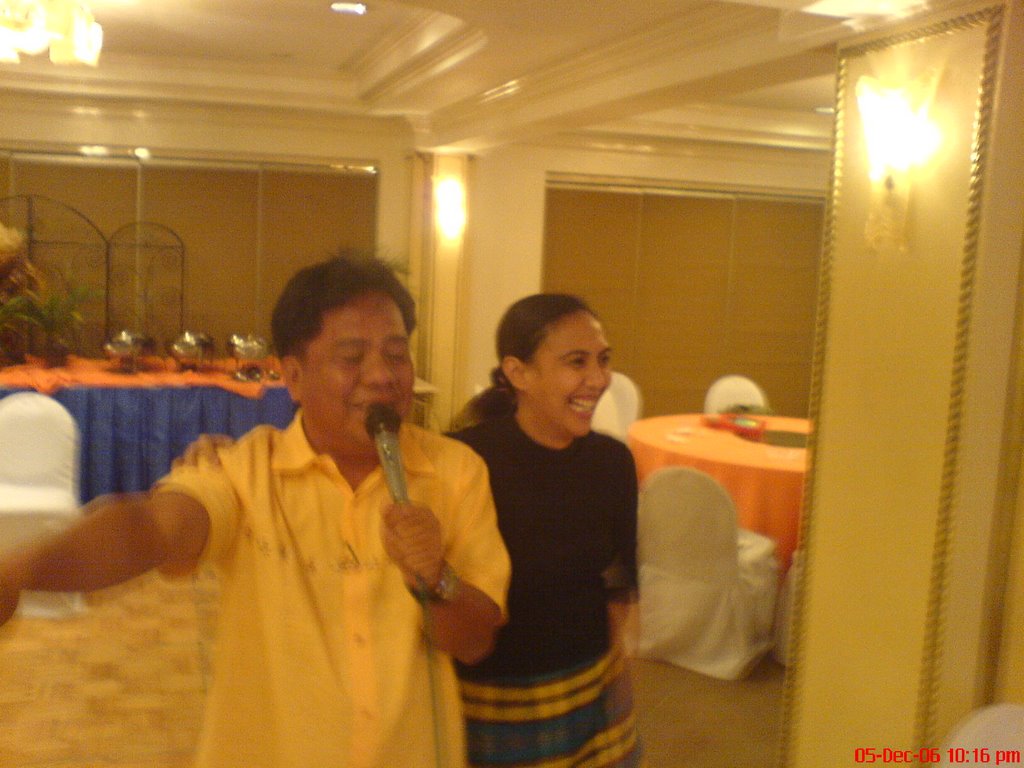
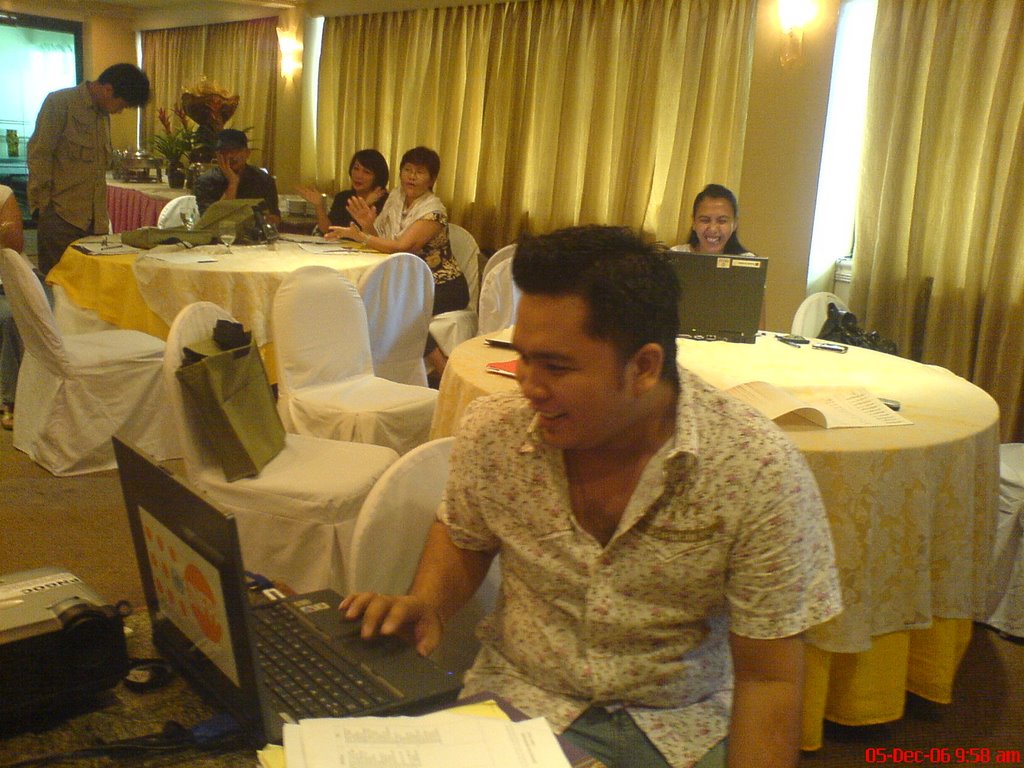
mga "patikim na pics" nung Project Review and Media Planning


When the media goes wild...

... pero this one tops it all... akalain mo, ganito pala si Ernie... still picture kasi... pero imagine this lad singing and dancing to the tune of " nakaka-aliw... nakakabaliw... "... or something like that guys...